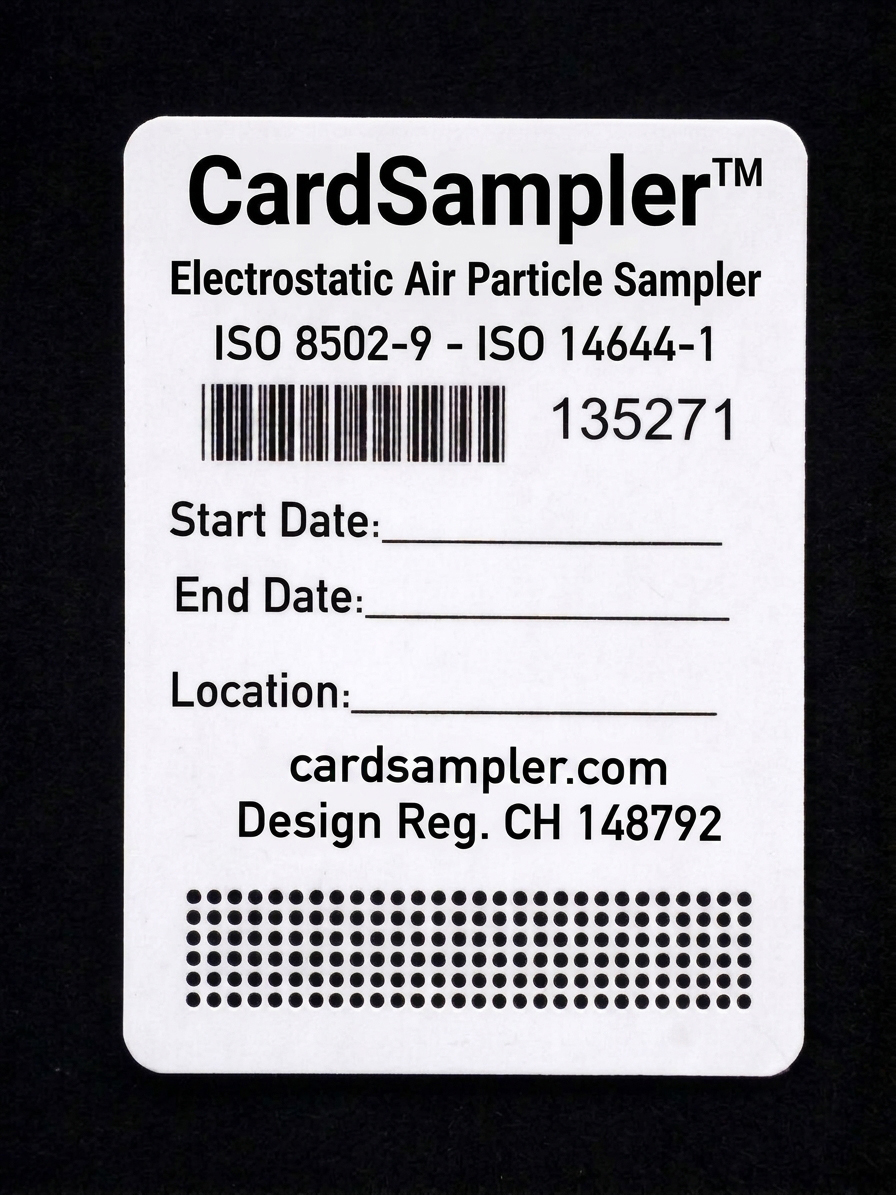
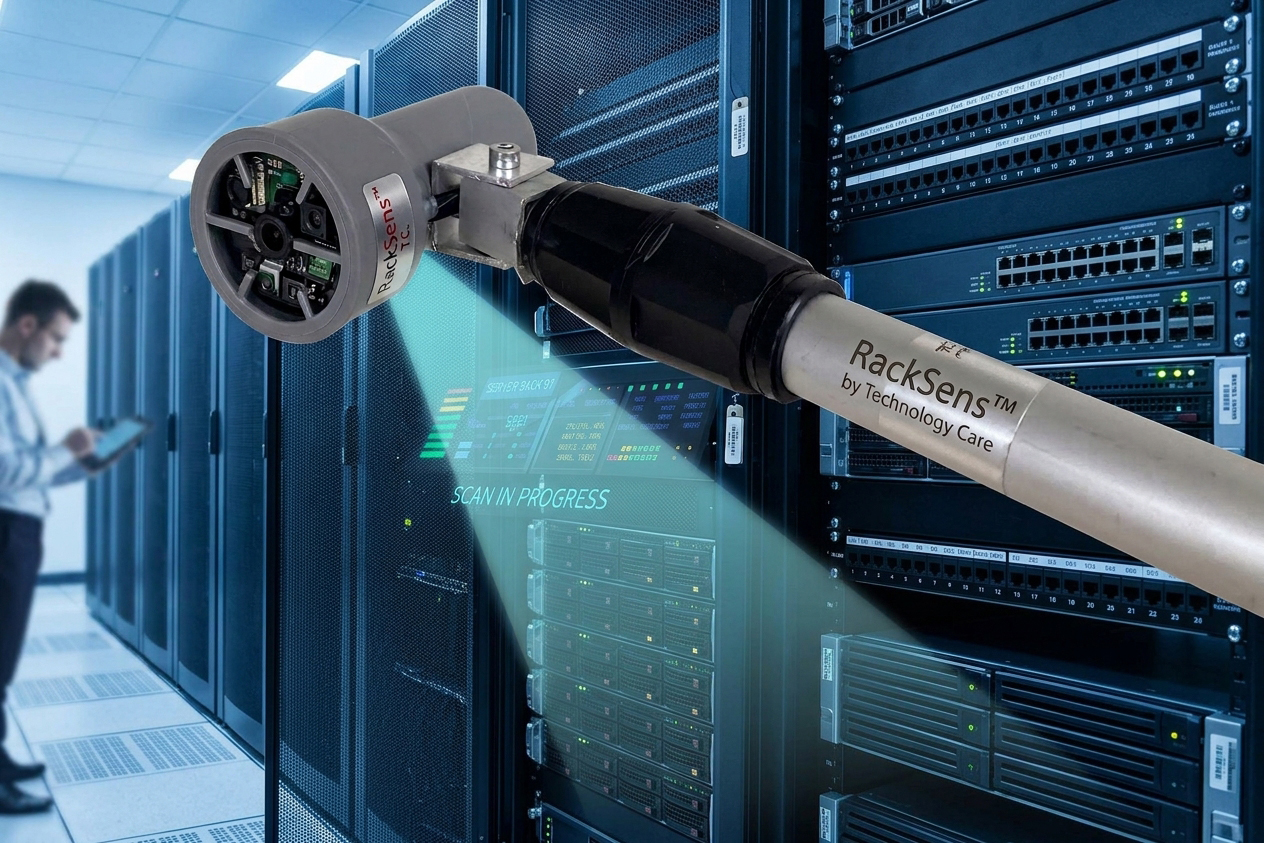
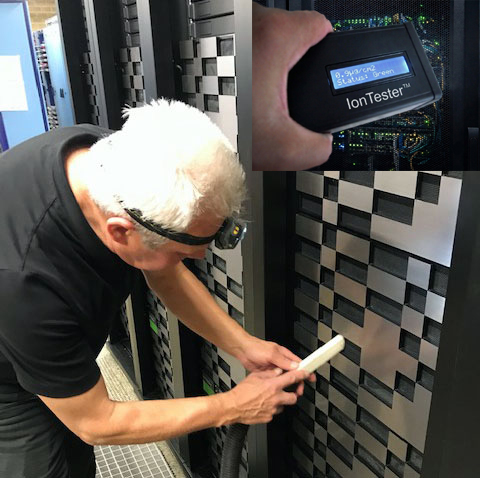
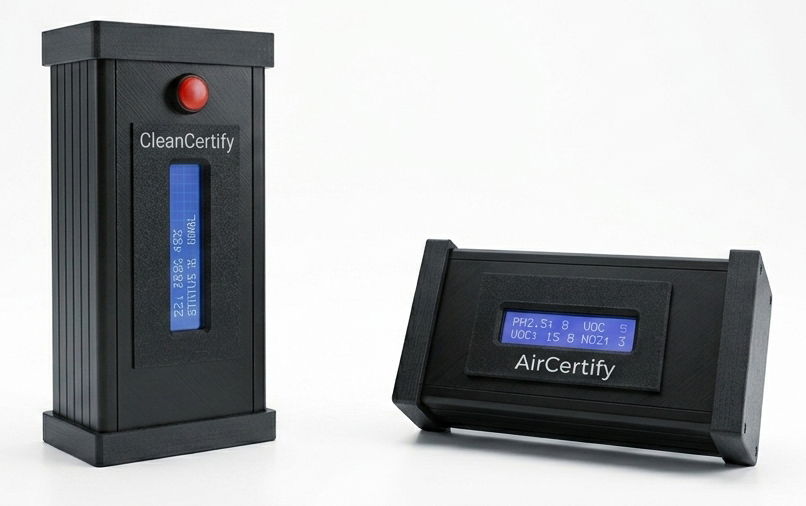
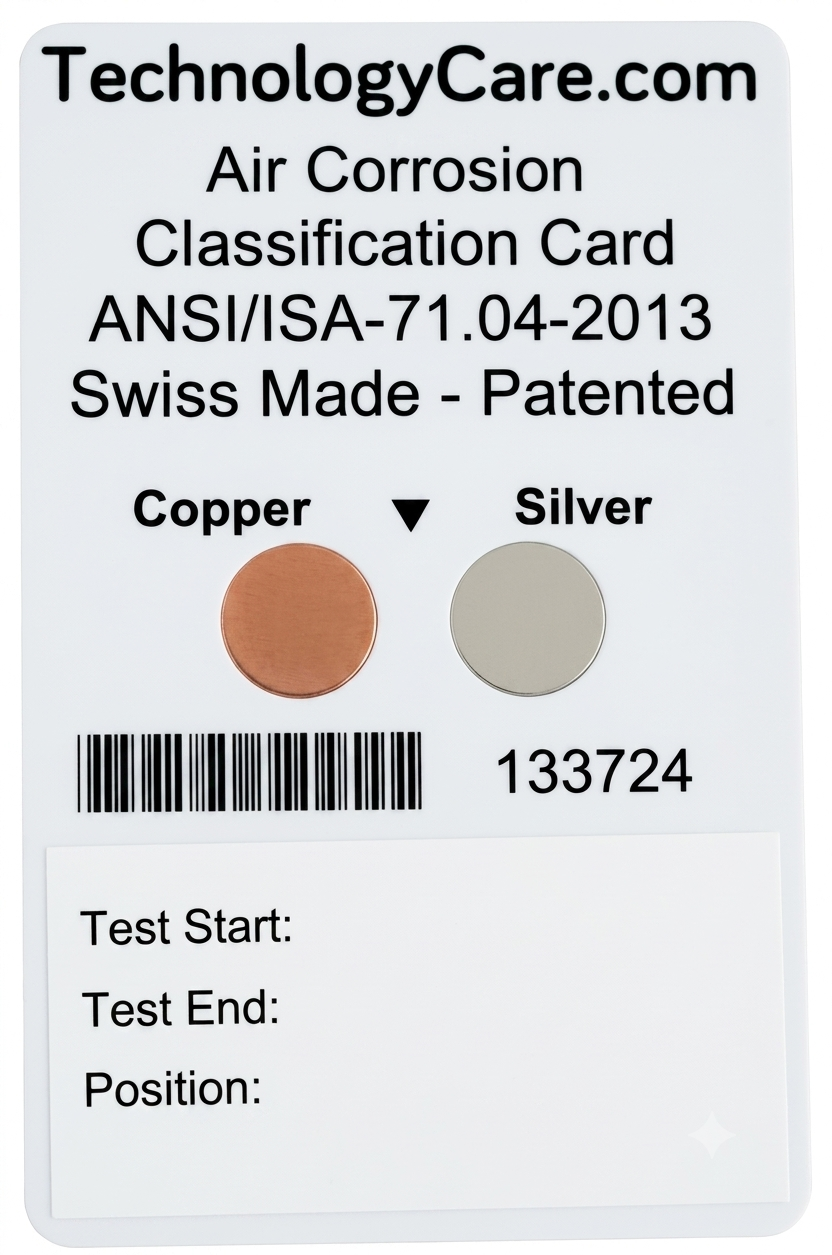
Most data center sensors watch airborne particles down to 0.5 micron and stop there — missing the smaller, largely ionic, highly corrosive particles down to the nano level. DustCard™ is a passive sampling card that uses electrostatic attraction to capture all of it, including nanoparticles, acting like an environmental black box for your rack intakes.
Pack of 10
Peel the adhesive tag and stick the card directly to a rack door or intake grille, exposed to direct airflow. Recommended on all or most rack intakes, since strong local airflow means particle events are often highly localized.
Leave the card in place as a continuous environmental black box, quietly recording particle events — from routine background dust to sudden events like smoke intrusion or extinguishing-gas discharge.
Whenever you need an environmental report — for a site audit or after a suspected particle event — remove the card and send it to our lab for analysis.
Receive a lab report covering air particle concentration per ISO 14644-1 and ionic contamination per ISO 8502-9 — the documentation auditors and insurers ask for.
A pack of 10 passive particle sampling cards, ready to mount and send for lab analysis whenever you need an answer. Each card uses electrostatic attraction to pull in and hold particles down to the nano level — including the ionic, corrosive fraction that standard 0.5-micron monitors leave invisible.
Standard data center monitoring watches airborne particles down to 0.5 micron and stops there. DustCard™ is built to catch everything below that, too — the submicron and nanoscale fraction that is often ionic and highly corrosive. A lab report covers particle concentration, ionic contamination and, where relevant, what that combination means for the risk to your hardware.
The card is analyzed to determine airborne particle counts across size bands, down to the submicron and nano range, and reported against the ISO 14644-1 cleanliness classification used for controlled environments.
| ISO Class | Typical Setting | Status |
|---|---|---|
| ISO Class 6–7 | Well-controlled data hall | ✓ Pass |
| ISO Class 8 | Elevated particle load | ⚠ Marginal |
| Above ISO Class 8 | Outside recommended range | ✗ Fail — High risk |
The card is eluted with a precise volume of deionised water and the extract's conductivity is measured, then converted to a total soluble salt reading — capturing the ionic, corrosive load that nanoscale particles disproportionately carry.
| Result | Limit | Status |
|---|---|---|
| < 5 µg/cm² | Electronics limit | ✓ Pass |
| 5 – 10 µg/cm² | Exceeds electronics limit | ⚠ Marginal |
| > 10 µg/cm² | Exceeds building/insurer limit | ✗ Fail — High risk |
Particles below roughly 0.1 micron don't behave like ordinary dust — they stay suspended indefinitely and act more like a corrosive fluid moving through your airflow. The report flags which mechanism is most relevant to your reading.
| Particle Size | Primary Mechanism | Status |
|---|---|---|
| 0.5 µm+ | Settled dust, thermal insulation | ✓ Monitored elsewhere |
| 0.1 – 0.5 µm | Fills heat sink micro-vortices, chokes cooling | ⚠ Often missed |
| < 0.1 µm (nano) | ESD infiltration, catalytic creep corrosion | ✗ High risk if elevated |
Data centers routinely watch particles down to 0.5 micron and stop there — but the physics changes below that. Sub-0.1-micron nanoparticles no longer settle like ordinary dust; they undergo Brownian motion, collide with gas molecules, and stay suspended indefinitely. Combined with the high-velocity airflow of modern AI and HPC clusters, they behave less like dust and more like a continuous, corrosive fluid moving through the infrastructure. A plain adhesive or gravity-settling surface largely misses this fraction, which is why DustCard™ uses an electrostatic capture surface: the same static charge that lets nanoparticles cling to circuit boards is what pulls them onto the card instead.
Nanoparticles threaten hardware through several distinct mechanisms. Because they're roughly the size of the spacing between modern chip circuits, they can settle inside multi-chip modules or under Ball Grid Arrays, carrying static charge that triggers localized electrostatic discharge. Their tiny size also means an enormous surface-area-to-volume ratio, so combustion byproducts like carbon black or diesel exhaust become far more chemically reactive at the nanoscale — accelerating "creep corrosion" on copper traces and silver solder joints, and producing subtle, silent data corruption long before a server visibly fails.
Nanoparticles also disrupt cooling itself. Rather than settling as a blanket on a heat sink the way larger dust does, they lodge in the micro-vortices between the ultra-fine fins of high-performance GPU and CPU heat sinks, choking the heat transfer coefficient and forcing fans to spin faster — quietly raising energy consumption along the way.
These particles arrive from outdoor air pollution and wildfire smoke, from the mechanical wear of fans and air handling units, and from live construction work happening nearby. Standard MERV 8 or MERV 13 filters are largely transparent to them. A card mounted directly on the rack intake, exposed to real airflow, is what catches what the room-level sensors miss.
Three reasons DustCard™ belongs at rack intakes, not just at the room level.
A pack of 10 DustCard™ samplers covers ten rack intakes, each acting as its own environmental black box. Lab analysis per ISO 14644-1 and ISO 8502-9 is available whenever you need a report. Worldwide UPS shipping is a flat $45 per order.
Plus US$45 flat-rate worldwide UPS shipping per order
Ships worldwide via UPS for a flat US$45 per order. Adhesive mounting tags and instructions included. Lab analysis available on request whenever you need a report.
Available Online — No Travel Required
Order your DustCard™ pack of 10 today — US$87, plus a flat US$45 worldwide UPS shipping fee per order. Mount one at every rack intake, and send any card for lab analysis whenever you need a report.