The ChlorAir™ kit places a passive sampling card in your technical space to measure airborne chloride deposition over time — flagging the chemical risk while it is still building, long before pitting, contact failure or trace damage becomes visible.
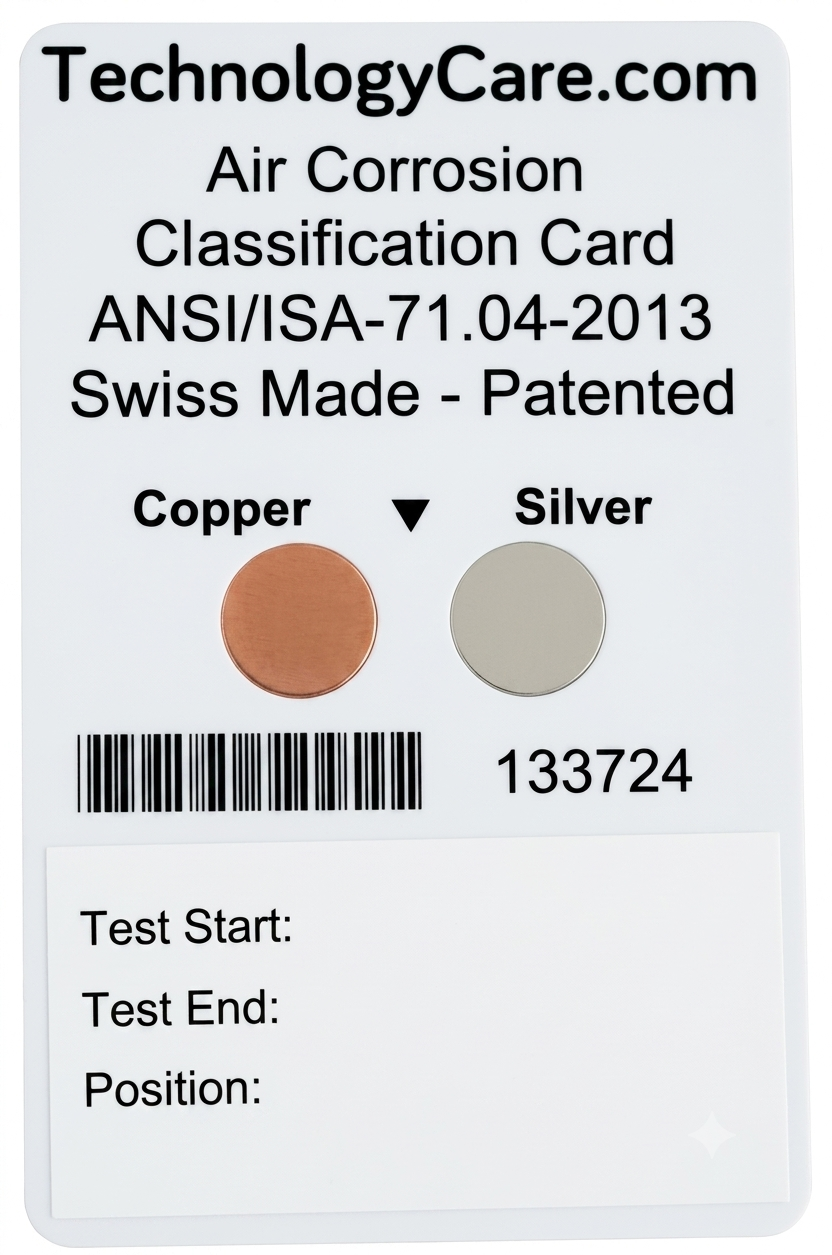
Unseal the sampling card and mount it in the airflow of the room or cabinet you want to monitor. No chemicals, no calibration, no specialist needed.
Leave the card in place for the standard 30-day period — or longer, for ongoing long-term monitoring of a room's airborne chloride trend.
Reseal the card and drop it in the included international postage-paid UPS return mailer. It ships directly to our Swiss laboratory.
Receive a certified ISO 8502-9 digital report covering total soluble salts, deposition rate and years-to-limit — delivered by email.
A passive airborne chloride sampling card, a Swiss lab analysis, no hidden fees. Designed for data centers, server rooms and industrial technical spaces where salt-laden air is a silent corrosion risk.
All three results measure corrosion potential, not corrosion damage itself — the point is to catch the risk while it is still chemical, not yet physical. Total soluble salts quantify what has already deposited on the card. Deposition rate projects how long your equipment has before reaching the corrosion limit. And because airborne chloride salts turn conductive at a lower humidity than most other contaminants, the deliquescence threshold tells you how much margin your room's climate control is really giving you before that potential becomes active corrosion.
The card is eluted with a precise volume of deionised water and the extract's conductivity is measured, then converted to chloride surface density — the total corrosive salt load the card collected during its exposure period.
| Result | Limit | Status |
|---|---|---|
| < 5 µg/cm² | Electronics limit | ✓ Pass |
| 5 – 10 µg/cm² | Exceeds electronics limit | ⚠ Marginal |
| > 10 µg/cm² | Exceeds building/insurer limit | ✗ Fail — High risk |
The lab divides the measured salt load by the exposure time to give a deposition rate, then projects how many years of continuous exposure at that rate it would take to reach the 10 µg/cm² limit — a direct read on your room's remaining margin.
| Years to Limit | Meaning | Status |
|---|---|---|
| > 5 years | Exceeds average IT equipment lifespan | ✓ Good |
| 1 – 5 years | Within typical equipment lifespan | ⚠ Review |
| < 1 year | Rapid accumulation | ✗ Fail — High risk |
Chloride salts on a board only corrode once the air is humid enough to dissolve them. Their deliquescence point sits near 57 % RH — noticeably lower than the ~70 % RH threshold used for many other airborne contaminants. Below it, the salt stays dry and the attack essentially stalls; cross it, and an electrolyte film forms and corrosion accelerates.
| Room RH | Salt State | Status |
|---|---|---|
| < 57 % RH | Dry, deposited but inactive | ✓ Stalled |
| 57 – 70 % RH | Intermittently dissolved | ⚠ Active |
| > 70 % RH | Continuously conductive electrolyte | ✗ High risk |
Corrosion potential and corrosion damage are two different moments in time. By the time pitting, contact resistance or a failed trace is visible, the chemistry that caused it has usually been sitting on the hardware for months. ChlorAir™ is built to catch the earlier moment — the chloride load quietly accumulating in the air — while it is still a measurable risk and not yet a failure.
Surface-dust tests only capture what has settled and stayed on a wipeable surface at the moment of sampling. Airborne chlorides are different: they arrive continuously with the air itself, deposit on every exposed surface inside a rack — connectors, contacts, PCB traces, cooling fins — and keep accumulating between cleaning cycles. A room can look clean on a surface wipe test and still be under sustained chloride attack from the air passing through it.
Deliquescence is the process where a solid salt deposit absorbs moisture from the air and turns into a liquid electrolyte film. This happens once ambient relative humidity crosses the salt's Deliquescence Relative Humidity (DRH). For common chloride salts, that point sits near 57 % RH — well below the 70 % RH threshold many conductivity checks use as their reference. Below 57 % RH, the salts stay dry and largely inert. Cross it, and the same deposit becomes a conductive, corrosive film that attacks copper traces and connector plating around the clock.
Because that threshold is lower than for most other salts, a data center run at a "safe" 55–65 % RH band can still spend part of every day above the chloride deliquescence point — a risk that a once-off wipe test, or a check calibrated to a higher RH, will not reveal. Continuous or periodic airborne monitoring is the only way to catch it.
Three reasons airborne chloride monitoring belongs alongside — not instead of — surface testing.
A single ChlorAir™ kit covers one sampling location for a standard 30-day exposure, both directions of shipping, and a full Swiss laboratory report against airborne chlorides per ISO 8502-9. The same kit can also be left in place longer for extended, long-term monitoring.
Worldwide UPS shipping included
Ships worldwide via UPS. Return mailer and Swiss lab analysis included — no additional fees. 30-day standard exposure, extendable for long-term monitoring.
Available Online — No Travel Required
Order your ChlorAir™ kit today — US$278, worldwide UPS shipping included. Our Swiss-certified specialists will walk you through card placement if you have questions, at no extra cost.