Swiss laboratory analysis · Aligned with ASHRAE TC9.9 & IPC-TM-650 Request Pricing →
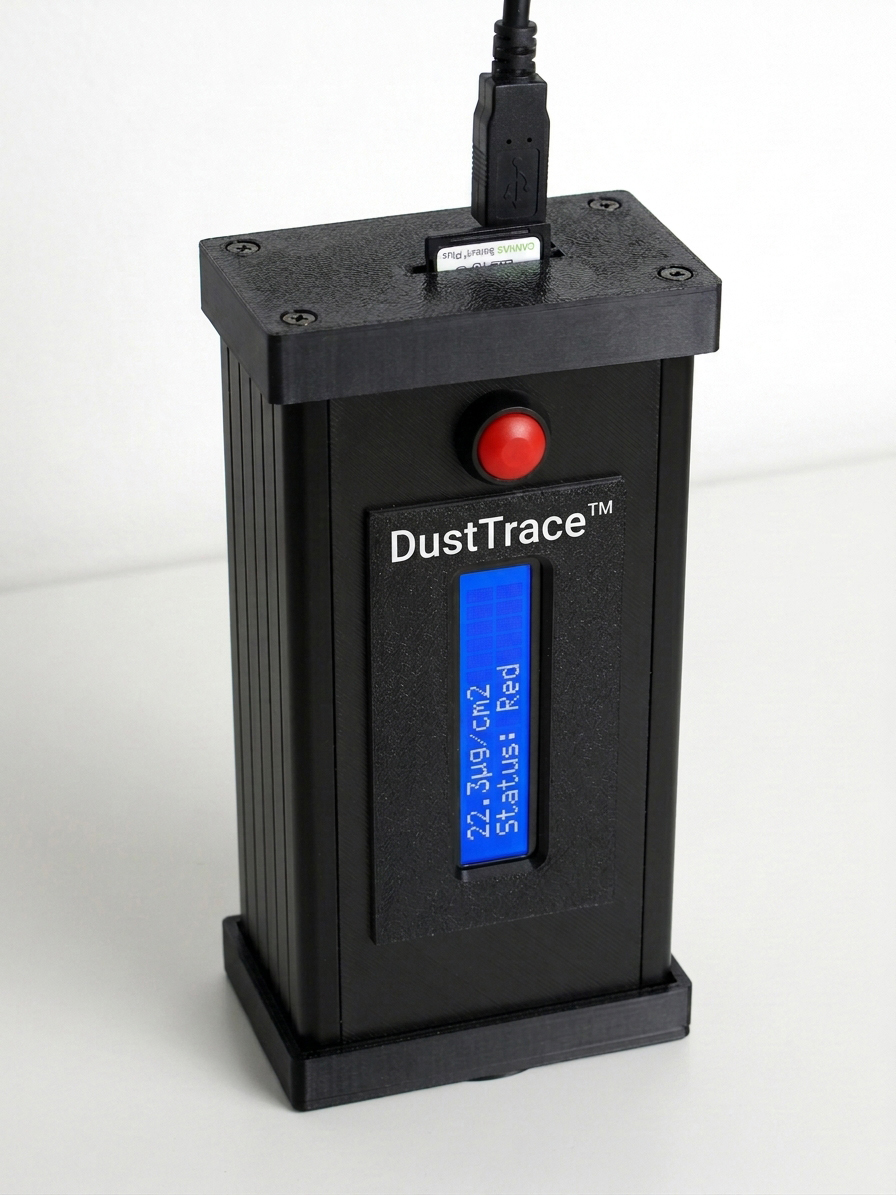
DustTrace™ — Swiss Dust Analysis

Is corrosive dust lurking in your data center?

The DustTrace™ kit tests surface dust for electrical conductivity and chemical corrosivity. One sampler, two precise lab analyses, actionable risk classification.

ASHRAE TC 9.9 aligned
IPC-TM-650 method
Swiss accredited lab
2
Precision lab tests
Patented Dust Card
Sampler — no chemicals needed
70%
RH exposure test
Bresle-method equivalent
No specialist required on-site
International postage-paid return mailer
Digital report delivered by email
Zurich, Switzerland
Process
How DustTrace™ Works

1. Collect

Wipe a rack or equipment surface with the patented dust card sampler. No chemicals, no specialist needed — takes minutes.

2. Mail

Seal the card and drop it in the included postage-paid international return mailer. It ships directly to our accredited Swiss laboratory.

3. Analyse

Our lab exposes the pad to 70 % RH and measures resistance, then performs a DI-water extraction to quantify ionic contamination and chloride surface density.

4. Report

Receive a certified digital report covering both test results, risk classification, and actionable recommendations — delivered by email.

DustTrace™ card sampler with cotton pad
Includes Return Mailer
The Kit

Everything You Need
in One Box

One sampler. Two precise analyses. No hidden lab fees. Designed specifically for technical environments including data centers, server rooms, and industrial facilities.

  • Test 1 — Resistance at 70 % RH: Quantifies whether dust has reached deliquescence, producing a Pass / Marginal / Fail classification.
  • Test 2 — Chloride Surface Density (Bresle-equivalent): Reports µg/cm² of chloride contamination — the industry standard for chemical corrosion risk.
  • International Postage-Paid Mailer — no extra shipping costs, worldwide.
  • Certified Swiss Lab Report delivered by email with risk level and recommended action.
Lab Analysis

Two Complementary Tests

Test 1 measures the physical behavior of dust today — will it cause a short circuit right now? Test 2 measures the chemical potential for future damage — will it corrode copper traces over time?

TEST 01

Resistance at 70 % RH

Physical Conductivity Test · Megohm measurement

The pad is exposed to a controlled 70 % relative humidity environment — the threshold at which many salts begin to deliquesce (dissolve into a conductive film). Resistance is then measured in megaohms to determine whether the collected dust poses an immediate short-circuit risk to circuit boards and connectors.

Condition Resistance Status
Clean cotton (baseline) 10¹⁰ – 10¹¹ Ω Baseline
Dusty pad — Pass 10⁹ – 10¹⁰ Ω ✓ Safe
Dusty pad — Marginal 10⁷ – 10⁸ Ω ⚠ Warning
Dusty pad — Fail < 10⁶ Ω ✗ Danger
Interpretation: A "Fail" result means deliquescence has occurred at 70 % RH — the dust is actively conductive and poses an immediate EOS (Electrical Overstress) risk. A "Warning" indicates partial wetting or high hygroscopicity and warrants further investigation.
TEST 02

Chloride Surface Density

Bresle-equivalent ionic extraction · µg/cm²

The pad is saturated with a precise volume of deionised water to extract soluble ionic contamination. Conductivity of the extract is measured and converted to chloride surface density — the primary risk indicator for pitting corrosion and PCB trace degradation per ASHRAE TC 9.9 and IPC standards.

Metric Unit Significance
Extract conductivity µS/cm Total ionic activity
Soluble salt density mg/m² Total salt loading
Chloride equivalent < 1.0 µg/cm² µg/cm² ✓ Clean / Pass
Chloride 1.0 – 2.5 µg/cm² µg/cm² ⚠ Marginal
Chloride > 2.5 µg/cm² µg/cm² ✗ Fail — High risk
Why chlorides? Chlorides are the primary corrosion driver in data center environments. They promote pitting corrosion, lower the Deliquescence Relative Humidity (DRH) of dust, and directly threaten copper PCB traces. Reporting µg/cm² enables cross-site comparison and aligns with IPC Pass/Fail criteria.
The Science

Why Dust in a Data Center Can Be a Ticking Clock

Dust in a technical environment can be entirely benign — or highly corrosive and conductive. The critical variable is its ionic composition. Corrosive dust containing soluble salts sits dormant until environmental relative humidity rises above a threshold, at which point it liquefies and begins attacking metal surfaces.

Dust deliquescence is the process where solid dust particles — particularly those containing soluble salts — absorb moisture from the air and dissolve into a liquid electrolyte. This occurs when the ambient RH exceeds the Deliquescence Relative Humidity (DRH) of the specific salt present. The result: increased particle adhesion, caking of dust layers, and dramatically increased corrosion rates on copper traces and connector surfaces.

A single particle event — a dusty fan, open floor tile, or nearby construction — can deposit months of latent corrosion risk that only manifests after the next humid season.

Test Rationale

Why Both Tests?

Neither test alone tells the full story. Together they provide a complete risk picture.

01
Test 1 answers: Is it dangerous now?
By exposing the pad to 70 % RH and measuring resistance, Test 1 reveals whether the dust has already reached its deliquescence point and is actively conductive — an immediate EOS risk to live equipment.
02
Test 2 answers: Will it corrode over time?
Chloride surface density quantifies the chemical potential for long-term damage. Even dust that passes Test 1 today can corrode copper traces over months if chloride levels are elevated — a risk invisible to conductivity measurements alone.
ASHRAE TC 9.9
Data Center Air Quality
DustTrace™ thresholds are aligned with ASHRAE TC 9.9 recommendations for hardware reliability and contamination risk classification in mission-critical facilities.
IPC-TM-650
Ionic Contamination Testing
Test 2 follows the spirit of IPC-TM-650 ionic contamination analysis, reporting chloride equivalent surface density as the primary Pass/Fail criterion for PCB longevity.
Bresle Method
Surface Salt Extraction
Using a fixed DI water volume and fixed pad area, our wash extraction produces Bresle-equivalent results — enabling direct cross-site comparison and professional lab reporting.

Available Online — No Travel Required

Ready to Test Your
Data Center Dust?

Request pricing and kit information for DustTrace™. Our Swiss-certified specialists will advise on the right sampling strategy for your facility — at no obligation.