Measure Today's Corrosion. Reveal Tomorrow's.
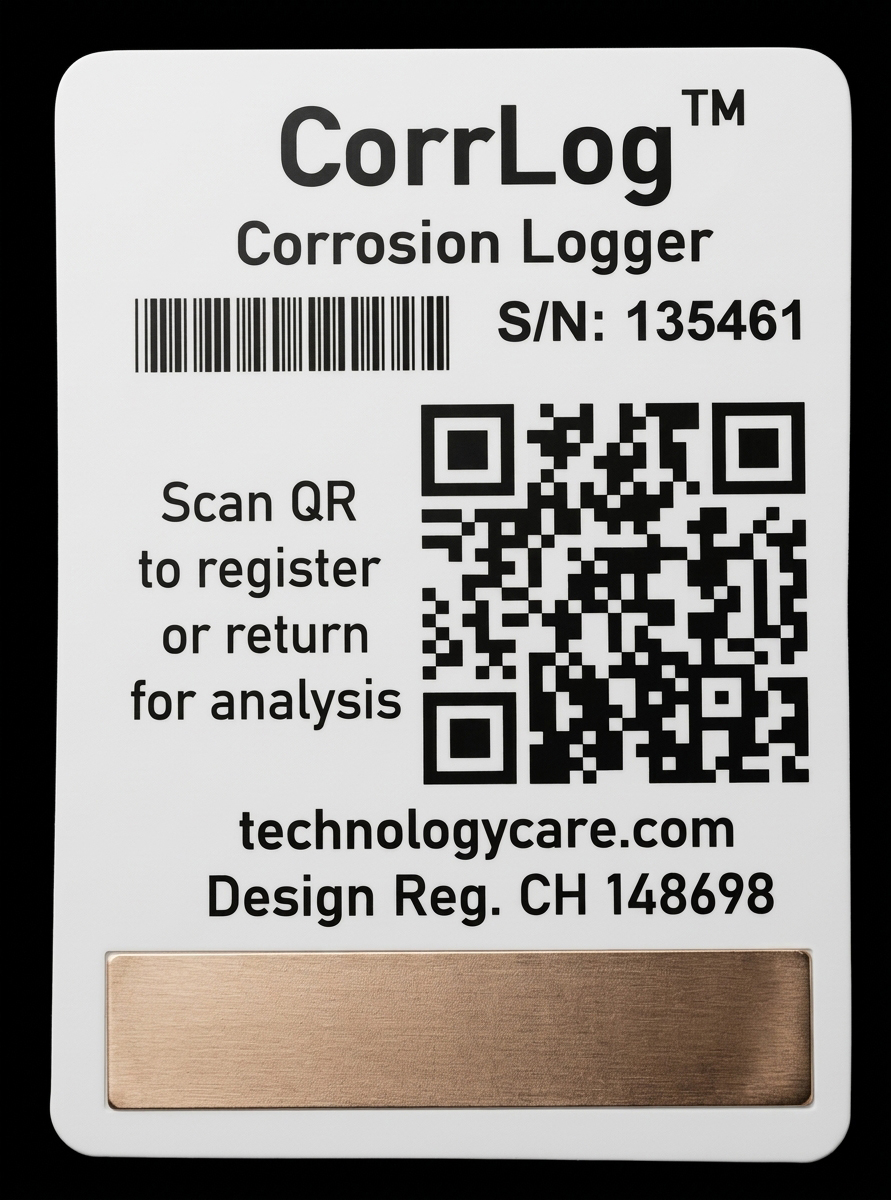
Ordinary corrosion classification coupons only tell you how much corrosion has already occurred. CorrLog™ also measures the chloride on your hardware — the corrosion the next humidity spike will cause. Actual and potential corrosion, in one passive sampler.
- Free Samplers & Free Shipping: For facilities and facility service providers
- More Than a Coupon: Ordinary classification coupons only show corrosion that has already occurred — CorrLog™ shows actual and potential corrosion
- Actual Corrosion to ANSI/ISA-71.04: Copper reactivity in Å per month, classified G1 to GX. Data centers should be G1 — below 300 Å/month
- Potential Corrosion from Chloride: Measures the chloride load that is harmless today but becomes corrosive when relative humidity rises
- Clear Limit Values: Chloride compared with 10 µg/cm² for buildings and 5 µg/cm² for electronics and data centers
- Passive & Maintenance-Free: No power, no wiring, no moving parts — mount it inside or outside racks and on room surfaces
- Swiss Laboratory Report: Both results in one report, with a clear interpretation for your facility
- Registered at Install & Removal: Scan the QR code to record date, location and photos — a documented exposure period for every result
ANSI/ISA-71.04 Severity
Copper reactivity in Å per month, classified G1, G2, G3 or GX. The data center target is G1: below 300 Å/month.
Chloride Contamination
Chloride load in µg/cm² to ISO 8502-9 — the corrosion that is waiting for the next humidity spike.
Free Including Shipping
Samplers and shipping are free for facilities and facility service providers. Tell us how many you need.
One Report, Two Answers
Is corrosion happening now? Is it waiting to happen? Both answered by an independent Swiss laboratory.
A Clean Reading Today Is Not a Guarantee for Tomorrow.
Standard corrosion monitoring tells you how corrosive your air has been. But chloride-laden dust can sit on equipment for months or years doing nothing — until relative humidity rises. That is why CorrLog™ measures actual and potential corrosion together.
Is Corrosion Happening Now?
A copper reference surface reacts with corrosive gases in the air, such as sulfur and chlorine compounds. The laboratory measures the corrosion film that has grown and reports it as Å per month, classified to ANSI/ISA-71.04.
Data centers should reach severity level G1: less than 300 Å/month on copper.
Is Corrosion Waiting to Happen?
Chloride deposited with dust, smoke or construction debris is dry and inactive at normal humidity, so it does not show up as corrosion yet. When relative humidity rises, chloride salts absorb moisture and form a corrosive film on the hardware.
CorrLog™ measures this hidden chloride load in µg/cm² to ISO 8502-9 before it becomes active.
How Hidden Chloride Becomes Corrosion
Chloride Deposited
Smoke, construction dust, outside air or an extinguishing-gas event deposits chloride-laden dust on equipment.
Dormant — Still G1
At normal humidity the chloride stays dry. Copper corrosion can still read G1, and everything looks fine.
Humidity Spike
An HVAC fault, free-cooling with humid outside air or a weather change lifts RH. The chloride absorbs moisture and becomes active.
Corrosion & Failures
Corrosion starts on contacts, connectors and circuit boards — reduced MTBF and unexplained failures.
A Coupon Looks Back. CorrLog™ Also Looks Ahead.
Ordinary corrosion classification coupons only tell you how much corrosion has already occurred during the exposure period. They cannot see chloride that is still dry and inactive — the corrosion that has not happened yet. CorrLog™ measures both actual and potential corrosion.
How Much Corrosion Has Occurred?
- Actual corrosion during the exposure period
- ANSI/ISA-71.04 severity level G1 – GX
- No chloride measurement — inactive chloride stays invisible
- No warning of what a humidity spike would cause
- A G1 result can be falsely reassuring
Answers one question: what has already happened.
Actual and Potential Corrosion
- Actual corrosion during the exposure period
- ANSI/ISA-71.04 severity level G1 – GX
- Chloride load in µg/cm² to ISO 8502-9, compared with 10 and 5 µg/cm² limits
- Early warning of corrosion waiting for the next humidity spike
- Free samplers and shipping, one Swiss laboratory report
Answers both: what has happened — and what is waiting to happen.
What the Lab Results Mean.
Every CorrLog™ report gives two results: the actual corrosion rate on copper, classified to ANSI/ISA-71.04, and the chloride load on the surface, compared with published limit values.
Actual Corrosion · ANSI/ISA-71.04 Copper Reactivity
ANSI/ISA-71.04 classifies the corrosivity of an environment by the corrosion film that grows on copper. ASHRAE TC 9.9 recommends severity level G1 for data centers.
Potential Corrosion · Chloride Load to ISO 8502-9
Surface contamination testing to ISO 8502-6 / ISO 8502-9 gives the ionic surface contamination, including chlorides, in µg/cm². Ionic contamination is particularly corrosive in environments with elevated relative humidity.
Buildings & General Installations
Limit value for ionic surface contamination in buildings and general technical installations.*
Electronics & Data Centers
Limit value for electronic equipment and sensitive installations such as data centers.*
Humidity Activates Chloride
Chloride salts are hygroscopic. Once relative humidity rises above a salt's deliquescence point, it absorbs water from the air and forms a conductive, corrosive film. For sodium chloride this happens at about 75% RH; magnesium and calcium chlorides become active at roughly 30–35% RH, and mixed dust deposits can become active at lower humidity than any single salt.
This is why a facility can read G1 for years and still suffer corrosion after a single humidity excursion — and why measuring the chloride load matters.
Copper severity levels: ANSI/ISA-71.04-2013, Environmental Conditions for Process Measurement and Control Systems: Airborne Contaminants, International Society of Automation. Data center recommendation: ASHRAE TC 9.9, Gaseous and Particulate Contamination Guidelines for Data Centers.
* For more information on chloride limit values, see: M. Tuchschmid and R. Werner, “Comparative Investigations of Corrosive Fire Gas Condensates: Chloride-Equivalent Contaminations” (Vergleichende Untersuchungen korrosiver Brandgaskondensate), Allianz Report 5/2001, pp. 204–211, EMPA (Eidgenössische Materialprüfungs- und Forschungsanstalt / Swiss Federal Laboratories for Materials Testing and Research), Dübendorf.
Two Results. Four Clear Answers.
Combining actual and potential corrosion turns a single number into a decision. This is how the two CorrLog™ results work together.
< 300 Å/month
Clean & Stable
No active corrosion and no significant chloride reserve. Keep monitoring to document the condition over time.
Hidden Risk
Corrosion looks fine today, but the chloride load is waiting for a humidity spike. Find the source, control humidity and consider cleaning.
≥ 300 Å/month
Corrosive Air
Corrosion is happening now, most likely driven by corrosive gases. Review outside-air intake, filtration and gas-phase filtration.
Active Corrosion
Corrosion is happening and chloride is fuelling it. Act promptly: identify the source, control humidity and assess clean-or-replace.
Mount It. Register It. Let the Lab Do the Rest.
CorrLog™ works quietly in the background. There is no power, wiring or routine maintenance. A quick QR scan at installation and at removal documents where it was and for how long, so the corrosion rate can be calculated for the exact exposure period.
Get Your Samplers
Tell us how many samplers you need — samplers and shipping are free. We recommend several per room, including near air inlets and in critical racks.
Mount & Register
Mount the sampler in seconds inside or outside racks, on doors, walls or near HVAC units. Scan the QR code to register the installation with a photo, date and location.
Records 24/7
The sampler passively records corrosion and collects chloride-laden dust for months or years, building a record over time until you need a lab report.
Register & Return
Scan the QR code again to register the removal, then send the sampler to the Swiss laboratory. You receive the ANSI/ISA-71.04 severity level and the chloride load in one report.
Registered In. Registered Out.
A corrosion rate is only meaningful if the exposure period is known. Each CorrLog™ sampler has its own serial number and QR code. Scan it when you install it and again when you remove it, and the result is tied to a specific location and time period.
Register Installation
- Serial number and installation date — the start of the exposure period
- Photos of the sampler in place
- Site, room and rack position (optional)
- Optional GPS location from the phone
- PDF record sent with a timestamp
Return for Lab Analysis
- Removal date — the end of the exposure period
- Photos of the sampler before removal
- Observations such as HVAC changes, humidity events or works
- Printed lab form and return shipping label
- All log information appears in the lab report
Why register twice? The corrosion rate is calculated per month of exposure, so the exact installation and removal dates matter. The registrations also document where the sampler was, supporting the credibility of the result in warranty discussions, insurance claims and audits.
Know Before It Fails.
Corrosion develops slowly and is usually discovered only when hardware fails. CorrLog™ gives you the numbers early, when there is still time to act.
Commissioning & Routine Checks
Question: Does the white space meet the G1 recommendation for data centers?
Answer: ANSI/ISA-71.04 severity level plus chloride load, documented for each location and period.
✦ Documented baseline for audits and customers.
Outside Air, Coast, Industry & Traffic
Question: Is outside air bringing corrosive gases or salt into the facility?
Answer: Copper corrosion shows gaseous attack; chloride load shows salt and particulate deposits.
✦ Basis for filtration and air-management decisions.
Construction, Smoke & Extinguishing Gas
Question: Did the event leave chloride on the equipment that could corrode it later?
Answer: Chloride load compared with the 5 µg/cm² limit for electronics — before a humidity spike activates it.
✦ Supports clean-or-replace and insurance decisions.
When a Hardware Vendor Blames Your Air
Question: Was the environment really corrosive where the equipment failed?
Answer: Independent Swiss lab report with the ANSI/ISA-71.04 severity level and chloride load, recorded right at the failed equipment.
✦ Independent laboratory evidence for the discussion.
Measure Both Kinds of Corrosion.
CorrLog™ samplers are free of charge, including shipping, for facilities and facility service providers. Tell us how many you need.
Plan several samplers per room. Corrosion and contamination can vary strongly between air inlets, racks and room surfaces.
- 1Tell Us How Many: Enter the number of samplers and your shipping address.
- 2We Ship Free: Your samplers arrive with mounting instructions — no shipping fee.
- 3Mount & Register: Inside and outside racks and near air inlets, then scan the QR code to register each installation.
- 4Register & Return: Scan the QR code again at removal and send the sampler to the Swiss laboratory for analysis.
Get Free CorrLog™ Samplers
Free of charge for facilities and facility service providers. Shipping included.
Free including shipping — for facilities and facility service providers. Quantities are subject to availability.
Actual and potential corrosion in one Swiss laboratory report.